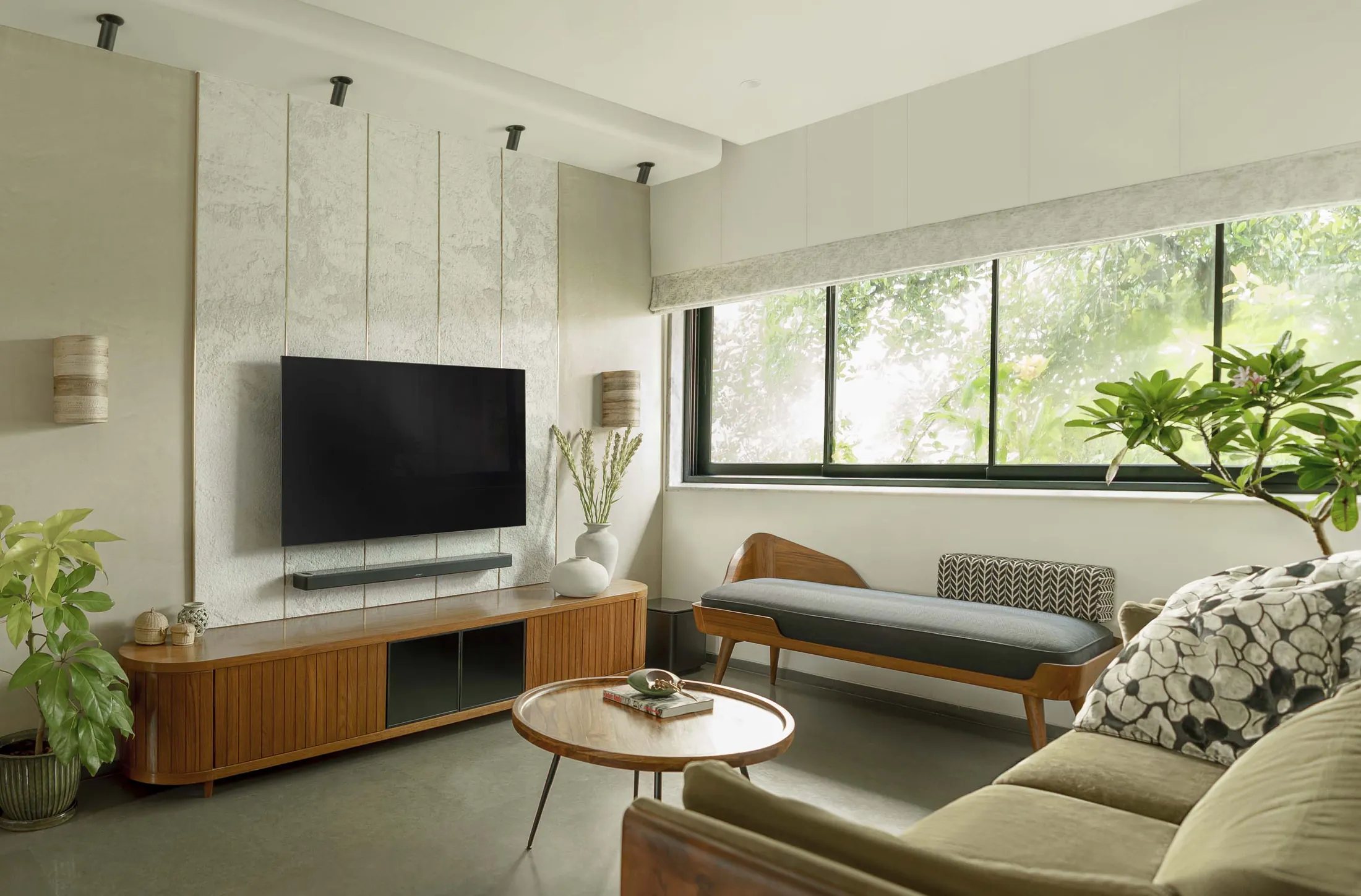
Walk into The Seed, our renovation of a family home in Gamdevi, and the first thing you notice is the walls. They’re soft and slightly uneven, with a warm matt surface that changes as the light moves. That’s hand-applied lime plaster, and it’s one of the materials we recommend most often.
what lime plaster is
Lime plaster is made from slaked lime (calcium hydroxide) mixed with sand or other aggregates, and sometimes natural additives. As it dries, it slowly reabsorbs carbon dioxide from the air and hardens back towards limestone. People in India have used it for centuries, in forts, havelis, temples and ordinary homes, long before cement arrived.
how it differs from cement plaster and POP
| Lime plaster | Cement plaster | POP / gypsum | |
|---|---|---|---|
| Breathability | High: lets moisture pass and evaporate | Low: can trap moisture in the wall | Medium, but weak in damp conditions |
| Flexibility | Slightly flexible; tolerates small movement | Rigid; prone to cracking with movement | Rigid |
| Best on | Old masonry, stone, brick, heritage walls | New concrete and block walls | Dry interior walls and ceilings |
| Finish | Soft, matt, hand-made, varied | Flat, needs paint | Very smooth, needs paint |
| Ageing | Develops character; patchable | Paint peels and needs redoing | Can soften or stain if damp |
why it suits mumbai
- Humidity. Mumbai walls spend months each year absorbing moisture. A breathable plaster lets it out again, instead of trapping it behind a film of paint, which is where damp patches, bubbling and mould start.
- Older buildings. Lime is compatible with traditional brick and stone masonry. Cement plaster on an old wall can make damp problems worse.
- Comfort. Lime helps buffer indoor humidity, and the matt surface reflects light softly, without glare.
where we use it
- Living rooms and bedrooms, as the main wall finish, often in warm off-whites.
- Niches and curved surfaces. Lime can be shaped by hand into rounded edges and recesses, as in The Seed’s niches inspired by the Kutchhi bhunga. More on that in bringing Kutch craft into a city home.
- Bathrooms, with care: specialised lime finishes (such as polished, sealed systems) can be used in wet areas. We detail them carefully and keep direct water zones in stone or tile.
what to expect
It isn’t perfectly uniform. That’s the point. Expect subtle variation in tone and texture. If you want a perfectly flat, single-colour wall, lime isn’t the right finish.
It takes skill. Results depend heavily on the craftsperson. Ask to see samples on site, at full size, in your light.
It takes time. Lime cures slowly, and good work needs multiple coats with drying time in between. Build that into the schedule.
Cost. Usually more than standard cement plaster and paint, because of material and skilled labour. Over the years it often comes out ahead, because it doesn’t need repainting every few years.
Care. Dust gently. Small marks and chips can be patched locally with the same mix. Avoid plastic emulsion paints over lime, which cancel out its breathability. Use lime-wash or mineral paints if you want to refresh the colour.
questions to ask before choosing it
- Is the wall old masonry or new concrete/block? (Lime shines on the former, and needs proper preparation on the latter.)
- Is there an active damp problem? (Fix the source first. Lime lets walls dry out, but it can’t stop a leak.)
- Do you like visible texture and variation?
- Does the contractor have real experience with lime, and can they show work in person?
Lime plaster is part of how we approach heritage homes and sustainable design. If you’re considering it for your home, talk to us.