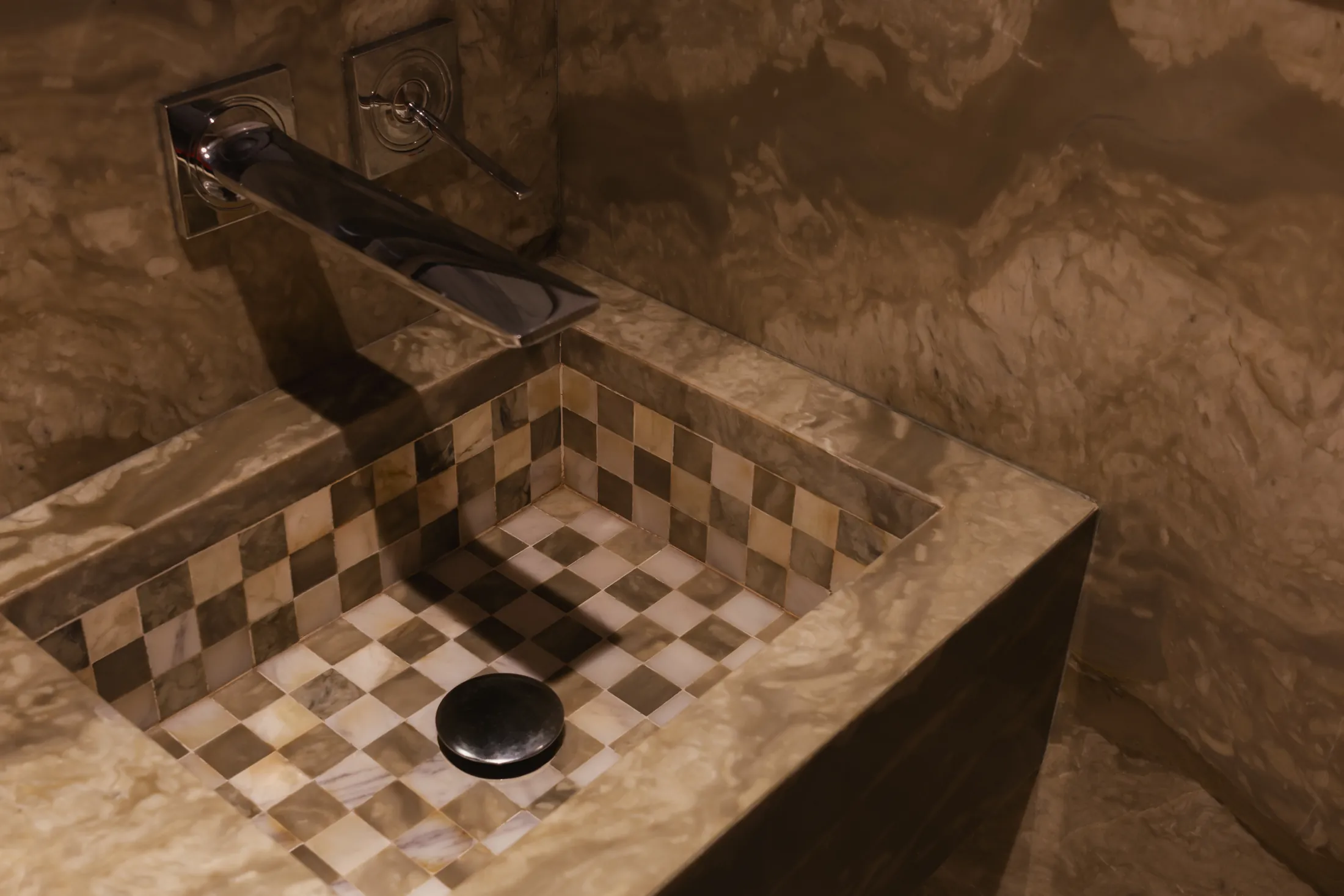
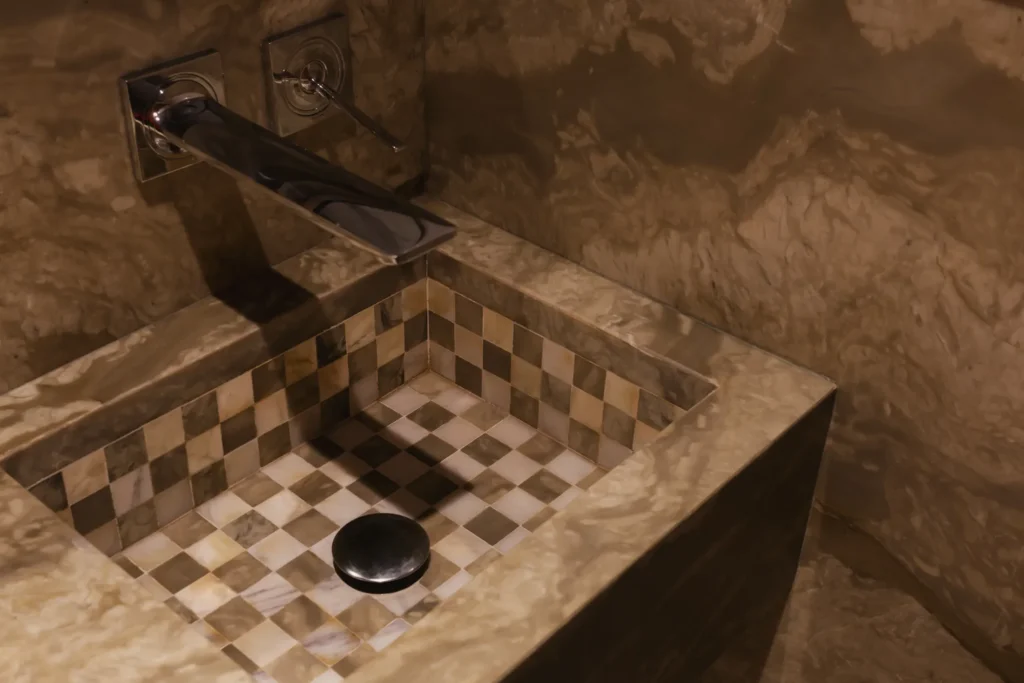
The powder room basin in home in•between is lined with a checkerboard made from marble offcuts. Pieces left from construction became a visible part of the finished home.
It is a small detail with several decisions behind it. Reusing a material does not remove the need to design, sort, fabricate and maintain it carefully.
begin with the pieces available
Offcuts come in different sizes, colours and thicknesses. The first task is to understand the usable supply. A pattern designed before that inventory can require more new material than expected.
For a similar idea, we would ask the fabricator to group the pieces and show what can be cut consistently. The pattern should respond to the supply rather than treat leftovers as if they were a new, uniform batch.
let the pattern organise variation
A repeated module can bring order to different stones. But a checkerboard still needs decisions about contrast, edges and where the pattern ends.
Review the arrangement at a useful scale. A few loose squares on a desk may look appealing without explaining the corners, drain or final border.
resolve it as a wet-area detail
The surface is only part of a basin. The supporting construction, joints, drainage and connection to the tap must work together. A decorative mosaic alone is not a waterproofing specification.
Ask the designer and fabricator how water will drain and how the joints will be finished. Approve a mock-up when the geometry or junctions are unfamiliar.
plan for cleaning
A material used beside water needs a clear care routine. The Natural Stone Institute recommends non-acidic cleaners for calcium-carbonate stone and notes that sealers do not make stone stain-proof.
Keep the instructions specific to the stones and jointing products actually used. A strong general-purpose cleaner may not be appropriate for the assembly.
keep the claim proportionate
We can say that this basin reuses marble offcuts from the project. We cannot turn that fact into an unmeasured claim about the carbon footprint of the whole home.
Reusing a material well is valuable in its own right. The detail also makes the act of reuse visible, without needing a label on the wall.
check the available quantity
Before cutting, confirm that there is enough suitable material for the agreed pattern and any sensible spares. Small differences can be accommodated deliberately, but an unexpected shortfall late in fabrication can change both the appearance and the work required.
read next
Explore our sustainable design work and the home in•between case study. For a related guide, read lime plaster walls guide.